Microchip's Vice President of Development Systems talks about the MPLAB X IDE at the Embedded Systems Conference in San Jose.
Showing posts with label Microchip. Show all posts
Showing posts with label Microchip. Show all posts
Thursday, June 02, 2011


Monday, May 10, 2010
Registration Open for Microchip’s 14th Annual Worldwide MASTERs Conference
Premiere Technical Training Event for Embedded-Control Engineers
The MASTERs Conference is a valuable resource for designing with Microchip products that provides design engineers with an annual forum for sharing and exchanging technical information on the Company’s 8-, 16- and 32-bit PIC® microcontrollers, high-performance analog and interface solutions, 16-bit dsPIC® digital signal controllers, wireless and mTouch™ sensing solutions, memory products, and MPLAB® development systems—including the industry’s only singular IDE to support an entire 8-, 16- and 32-bit microcontroller portfolio.
Read the full press release.
Wednesday, March 03, 2010
Embedded TCP/IP Network Module from LJCV Electronics
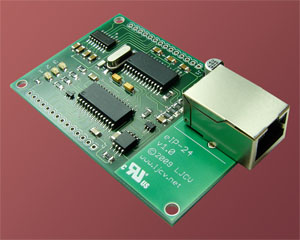
Do you want to play with Microchip's PIC24HJ128GP202 16-bit Microcontroller and ENC424J600 new 10/100Mbps Ethernet Network Controller? LJCV Electronics has a fun network development board for you. The eIP-24/100 is a small network module that will assist you in early development of a networked microcontroller based application and allow you to put together a proof-of-concept for a new product. Electronics enthusiasts can use it to quick start fun projects.
The circuit board includes all required components for both controllers, a serial 32Mbit Serial Flash for storage of board configuration, HTML pages and graphic files, a 23K256 Serial RAM, LEDs for health and board activity, and a RJ-45 jack for connection to an Ethernet Local Area Network.
The board ships fully assembled and tested, and pre-loaded with Microchip's TCP/IP Stack firmware.
Check it out at the LJCV Electronics website.
Wednesday, February 24, 2010
Electronic Design talks MPLAB IDE
Technology Editor Bill Wong and Microchip's Joe Drzewiecki discuss Microchip's IDE, MPLAB IDE, including related HI TECH and MPLAB C compilers and monitoring facilities.
Watch the video here: http://bit.ly/9Exta0
Watch the video here: http://bit.ly/9Exta0
Friday, December 18, 2009
Eflightworks.net PIC32 on a DIP
 Introducing a new tool for universities and educational institutions enabled with Microchip’s PIC32 32-bit microcontroller. The Eflightworks.net PIC32 on a DIP allows you to create and perform labs using a PIC32 in a form factor that fits on a typical breadboard. At the heart of the board is Microchip’s PIC32MX4 USB processor.
The PIC32 on a DIP board features:
- PIC32MX440F256H 64-pin USB microcontroller
- 8-MHz primary crystal
- 32.768-kHz Secondary crystal (for RTCC)
- USB device operation
- Power from USB or external battery
- microUSB connector
- Access to all I/O pins
- 4 programmable LEDs
- 2 programmable switches
- 2.6-x-0.8 52-pin DIP format
- MCLR switch
- ICSP header
Wednesday, September 16, 2009
Microchip Puts “Cash for Clunkers” Development Tool Exchange Program in Gear
Microchip’s Cash for Clunkers program allows embedded designers who are tired of looking at the faded paint jobs on their old tools to exchange selected models from Microchip’s competitors for a rebate as high as 30%—up to a $120 savings—on select PIC® Microcontroller, memory and analog development tools. But you’d better act fast—the program ends on October 30, 2009. Of course, Microchip will dispose of all exchanged competitor tools in an appropriate manner.Read the press release for more information
Monday, September 14, 2009
Robotics Development Kit Announced by Microchip and Digilent
Microchip Technology today announced the availability of a PIC32 32-bit microcontroller (MCU)-based robotics development kit through Digilent Inc. The Digilent Cerebot™ 32MX4 Robotics Development Kit (part # 32MX4) comes with a free version of Microchip’s MPLAB C Compiler for PIC32 and an integrated programming/debugging circuit that is compatible with the free MPLAB® IDE.
Read the full press release: http://bit.ly/41KLUK
Read the full press release: http://bit.ly/41KLUK
Monday, August 24, 2009
[Embeded.com] Embedded multitasking with small MCUs
Keith Curtis posted an article about embedded multitasking on small microcontrollers over on embedded.com.
Check it out. It's a good read if you're interested in embedded multitasking.
Multitasking is the ability to execute multiple separate tasks in a fashion that is seemingly simultaneous. Note the phrase "seemingly simultaneous." Short of a multiple processor system, there is no way to make a single processor execute multiple tasks at the same time. However, there is a way to create a system that seems to execute multiple tasks at the same time.
Check it out. It's a good read if you're interested in embedded multitasking.
Sunday, April 26, 2009
Microchip introduces nanoWatt XLP Technology
As more electronic applications require low power or battery power, energy conservation becomes paramount. Today’s applications must consume little power, and in extreme cases, last for up to 15-20 years, while running from a single battery. To enable applications like these, Microchip has introduced nanoWatt XLP™ Technology. Products with nanoWatt XLP Technology offer the industry’s lowest currents for Sleep, where extreme low power applications spend 90%-99% of their time.
Monday, April 20, 2009
Xiaofan's Blog: PICkit 2 under Arch Linux with pk2cmd
Xiaofan Chen explains how to run PICkit 2 under Arch Linux with pk2cmd in a blog posting. Check out the instructions over on Xiaofan's blog.
Thursday, April 09, 2009
Save PIC32 code (and maybe data) space by providing exit() in MPLAB C32
The default exit() function, provided with the MPLAB C Compiler for PIC32 MCUs and called by the default startup code, does a lot of clean up that your application might not require. It does things like flushing I/O buffers. This could be completely unnecessary if your application never exits from your main function().
You might want to consider providing your own exit() function to override the default implementation. This can save both code space and data space.
If you're not using standard I/O, this stub implementation can save about 1 KB of code space and even some data space. Just add it to your project.
You might want to consider providing your own exit() function to override the default implementation. This can save both code space and data space.
If you're not using standard I/O, this stub implementation can save about 1 KB of code space and even some data space. Just add it to your project.
void exit(int status)Even if you are using standard I/O, this stub could still save you a little space.
{
while(1);
}
Tuesday, April 07, 2009
Testing the PIC32 I/O Speed
Over on the Microchip web forums, it's not uncommon for someone to ask about how to achieve the PIC32's maximum I/O speed. The question seems to come up every few weeks. Lucio Di Jasio has a great blog post and example MPLAB IDE project showing how to get the most out of your PIC32 I/O. Theoretically, the peripherals can operate at the same top speed as the PIC32 core, 80 MHz. Lucio shows you how to get as close to the theoretical maximum as possible.
Saturday, April 04, 2009
PIC32 Design Challenge Top 5 from the ESC Keynote
Here's the video from the 2009 ESC West Keynote. It shows the top 5 designs in the PIC32 Design Challenge. See more at http://www.mypic32.com
Tuesday, March 31, 2009
Microchip Awarded EE Times ACE Award - Company of the Year

The EE Times Annual Creativity in Electronics (ACE) Awards celebrate the creators of technology who demonstrate leadership and innovation in the global industry and shape the world. This year, Microchip was awarded the EE Times ACE Award for “Company of the Year,” during a ceremony at the Embedded Systems Conference in San Jose, CA.
Monday, March 30, 2009
PIC32 awarded EDN's 19th Annual Innovation Awards

EDN bestowed its 19th Annual Innovation Awards, honoring a diverse group of electronics engineers and the ground-breaking products they have produced. Microchip's PIC32 32-bit microcontroller was chosen in the Microcontroller category. Follow this link for the complete list of awards.
Friday, March 27, 2009
PICDEM Touch Sense 2 Demonstration Board with Diagnostic Tool
The PICDEM Touch Sense 2 Demonstration Board provides a complete platform introducing Microchip's mTouch Sensing Solutions employing the 16-bit PIC24F MCU. It features the Charge Time Measurement Unit (CTMU) for fast capacitive touch sensing without additional external components.
Factory programmed firmware provides immediate access to all the boards features through the use of the accompanying Windows-based diagnostic tool. The diagnostic tool provides a platform to analyze application critical information in real time as it relates to touch sensor behavior.
Features:
- Populated with PIC24F256GB110 MCU
- Directional pad, keypad and slider sensor
- ICSP programming capability
- The PICdem Touch Sense 2 Demonstration Board
- USB cable
- mTouch Sensing Solutions CD-ROM, with users guide, reference manuals, source code, MPLAB IDE and mTouch diagnostic tool software.
Learn more at http://www.microchip.com/mtouch
Monday, March 16, 2009

Microchip announced the PICDEMTM Lab Development Kit (part # DM163035), a comprehensive, entry-level development platform for all of Microchip's 8-bit Flash PICR microcontrollers (MCUs) with 20 or fewer pins. Geared toward educators, students and those who are new to microcontrollers, the PICDEM Lab Development Kit comes complete with a development board containing five popular 8-bit PIC MCUs; a bag of discrete components; a PICkit 2 Debugger/Programmer; and a CD containing a User's Guide, labs and application examples. The kit provides everything needed to quickly and easily develop applications using Microchip's 8-bit PIC MCUs.Read the full press release here.
Monday, March 09, 2009
Microchip Acquires HI-TECH Software
 Microchip today announced it has acquired HI-TECH Software, a world-class provider of development tools for embedded systems based in Brisbane, Australia. Best known for its high-performance ANSI C compilers, featuring the optimizing, whole-program compilation technology, Omniscient Code Generation, HI-TECH Software has been a premier third-party provider of C compilers for Microchip’s 8-, 16- and 32-bit PIC® microcontrollers (MCUs) and dsPIC® Digital Signal Controllers (DSCs) for over a decade.
From now until September 30, 2009, Microchip is offering a 20% discount on Microchip development tools for HI-TECH customers through http://www.microchipdirect.com, and a 50% exchange discount to owners of HI-TECH compilers for non-Microchip products. Please contact HI-TECH for details.
Read the full press release here.
Friday, March 06, 2009
MPLAB C Compiler for PIC32 MCUs v1.05 Released
New Features in v1.05
Student Edition renamed Evaluation Version -- The student edition has been renamed the valuation version. This release also introduces a new academic version.
Improved 16- and 32-bit FFT functions in the DSP Library -- The FFT functions have been significantly improved and optimized for the PIC32 instruction set. See the 32-bit Language Tools Libraries document (DS51685) for more information. Please visit Microchip's website for the revision C of this document (DS51685C).
Binary Constants -- A sequence of binary digits preceded by 0b or 0B (the numeral '0' followed by the letter 'b' or 'B') is taken to be a binary integer. The binary digits consist of the numerals '0' and '1'. Note that this binary-constant syntax may not be accepted by other C compilers.
Linker Memory-Usage Report -- This optional, informational report allows you to easily determine the program- and data-memory usage of your application. It allows you to see how much space is used by the project being linked and how much space is available on the target device. The memory-usage report appears on stdout and in the optional map file.
- Using this feature with MPLAB IDE 8.20 and earlier -- On the linker's tab of the project build options, select to Use Alternate Settings. Add the --report-mem option to the Alternate Settings field. The memory-usage report will appear in the output window after a project build. (This option will appear as a checkbox in later MPLAB IDE releases.)
- Using this feature on the command prompt -- Add the --report-mem option to the linker's command line. If you are calling the linker via the compilation driver, use the driver's -Wl option to pass the --report-mem option to the linker. The memory-usage report will appear on stdout.
Improved malloc implementation -- This release contains a new malloc/free/realloc implementation based on the implementation written by Doug Lea and released to the public domain.
- This is not the fastest, most space-conserving, most portable, or most tunable malloc ever written. However it is among the fastest while also being among the most space-conserving, portable and tunable. Consistent balance across these factors results in a good general-purpose allocator.
- For a high-level description, see http://g.oswego.edu/dl/html/malloc.html
- This implementation is also provided with the Newlib C Library.
Instruction Macros -- The p32xxxx.h include file now contains a Nop() macro that issues a superscalar SSNOP instruction.
gettimeofday() weak stub -- The time.h clock() and time() functions require a user-provided gettimeofday() helper function. The compiler's library now provides a weak stub implementation that allows the project link to complete without error, but you should provide your own implementation appropriate for your application.
Microchip DSP Compatibility Wrapper functions -- This release provides new DSP wrapper functions intended to ease the migration from the Microchip DSP library for dsPIC DSCs to the general DSP library for PIC32 MCUs. See the 32-Bit Language Tools Libraries (DS51685C) document for more information on these new wrapper functions.
Updated peripheral-library documentation -- The 32-bit peripheral library document is now distributed as a compiled help file (*.chm) rather than a PDF file.
Support for PWP configuration bits -- The config pragma now supports enabling the Program Write Protect bits. See the PIC32MX Config Settings help file for information on the setting name and available values for each device.
Wednesday, March 04, 2009
New AnalogTalk.com Blog

The Microchip Technology Analog Products group is just getting started with their new blog. Check it out and give them some support. I hear that they are looking for topics to write about and I'm sure they would be happy to hear your suggestions. :-) Visit their blog here.


