Showing posts with label PIC. Show all posts
    Showing posts with label PIC. Show all posts

    Wednesday, March 03, 2010

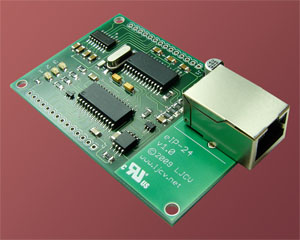
    Embedded TCP/IP Network Module from LJCV Electronics


    Do you want to play with Microchip's PIC24HJ128GP202 16-bit Microcontroller and ENC424J600 new 10/100Mbps Ethernet Network Controller? LJCV Electronics has a fun network development board for you. The eIP-24/100 is a small network module that will assist you in early development of a networked microcontroller based application and allow you to put together a proof-of-concept for a new product. Electronics enthusiasts can use it to quick start fun projects.

    The circuit board includes all required components for both controllers, a serial 32Mbit Serial Flash for storage of board configuration, HTML pages and graphic files, a 23K256 Serial RAM, LEDs for health and board activity, and a RJ-45 jack for connection to an Ethernet Local Area Network.

    The board ships fully assembled and tested, and pre-loaded with Microchip's TCP/IP Stack firmware.

    Check it out at the LJCV Electronics website.

    Monday, April 20, 2009

    Xiaofan's Blog: PICkit 2 under Arch Linux with pk2cmd

    Xiaofan Chen explains how to run PICkit 2 under Arch Linux with pk2cmd in a blog posting. Check out the instructions over on Xiaofan's blog.

    Monday, March 16, 2009


    Microchip announced the PICDEMTM Lab Development Kit (part # DM163035), a comprehensive, entry-level development platform for all of Microchip's 8-bit Flash PICR microcontrollers (MCUs) with 20 or fewer pins. Geared toward educators, students and those who are new to microcontrollers, the PICDEM Lab Development Kit comes complete with a development board containing five popular 8-bit PIC MCUs; a bag of discrete components; a PICkit 2 Debugger/Programmer; and a CD containing a User's Guide, labs and application examples. The kit provides everything needed to quickly and easily develop applications using Microchip's 8-bit PIC MCUs.
    Read the full press release here.

    Thursday, February 19, 2009

    HOMEBREW WEATHER SATELLITE Automatic Picture Transmission RECEIVER


    This project is a very nicely designed weather satellite image receiver. The project write-up has the hardware schematic along with many nice photographs of the hardware in action. Take a good look at how much you can do with a simple PIC16F628 microcontroller.
    http://noaa-apt-homebrew-rx.blogspot.com/

    Thursday, December 18, 2008

    Videos: MPLAB ICD 3 In-Circuit Debugger

    MPLAB® ICD 3 In-Circuit Debugger System is Microchip's most cost effective high-speed hardware debugger/programmer for Microchip Flash Digital Signal Controller (DSC) and microcontroller (MCU) devices. It debugs and programs PIC® Flash microcontrollers and dsPIC® DSCs with the powerful, yet easy-to-use graphical user interface of MPLAB Integrated Development Environment (IDE).

    The MPLAB ICD 3 In-Circuit Debugger probe is connected to the design engineer's PC using a high-speed USB 2.0 interface and is connected to the target with a connector compatible with the MPLAB ICD 2 or MPLAB REAL ICE systems (RJ-11). MPLAB ICD 3 supports all MPLAB ICD 2 headers.

    Video: MPLAB IDE Pre- and Post-Build Options

    This tip, from one of Microchip's Field Applications Engineers, shows MPLAB IDE users how to set up pre- and post-build batch files for execution as part of the project build process.

    Video: Introduction to mTouch Capacitive Touch Sensing

    Touch sensing is fast becoming an alternative to traditional pushbutton switch user interfaces, because it requires no mechanical movement, and it enables a completely sealed and modern-looking design. Expanding beyond the consumer market, touch sensing is beginning to take hold in medical, industrial and automotive applications for reasons such as aesthetics, maintenance, cost and cleanliness.
    Microchip’s mTouch™ Sensing Solution provides a free and easy method for designers to add touch sensing to applications utilizing PIC® microcontrollers without the cost of fee-based licensing and royalty agreements. Being a source-code solution further helps engineers quickly integrate touch sensing functionality with their existing application code in a single, standard microcontroller, thus reducing the total system cost associated with current solutions.